


Latest articles


Gérard
Co-founder / Team Principal
Larrousse
1987-1994
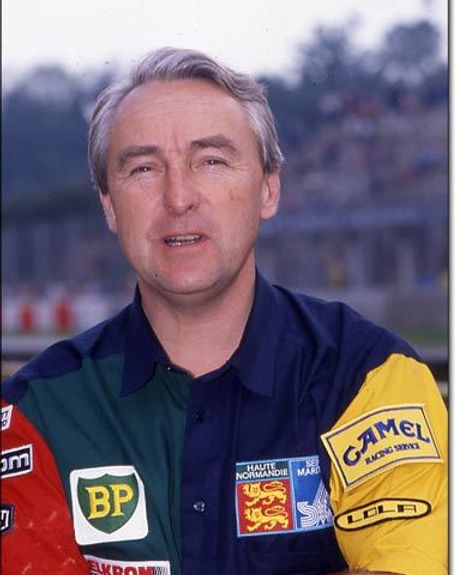
In the history of Larrousse F1, Gérard Larrousse is above all the architect of the project: the man who transformed an intuition – to build a credible French Formula 1 team in the late 1980s – into a real, committed structure capable of competing with industrial giants. His profile is quite unique: Larrousse arrived not only as a former driver, but as a man who had already learned motor racing from the inside, on the management side. Before Larrousse F1, he notably managed programmes at Renault Sport, then was sporting director at Ligier in the mid-1980s, a decisive experience in understanding the workings of modern F1: organisation, technical decisions, driver management, partner search and economic survival.
La naissance de l’écurie se fait avec Didier Calmels. Le projet est lancé à la fin de 1986 et s’incarne en championnat du monde à partir de 1987. Dès le départ, la signature Larrousse, c’est une équipe qui cherche des solutions pragmatiques : s’adosser à des châssis et des compétences externes, assembler des partenariats techniques, et composer avec les réalités budgétaires d’une petite structure indépendante. Les années passent, la F1 se professionnalise encore, et Larrousse doit constamment réinventer son modèle pour rester dans le jeu.
The team was founded by Didier Calmels. The project was launched at the end of 1986 and became a reality in the world championship in 1987. From the outset, Larrousse was a team that sought pragmatic solutions: relying on external chassis and expertise, forming technical partnerships, and dealing with the budgetary realities of a small independent structure. As the years passed, F1 became increasingly professional, and Larrousse had to constantly reinvent its model to stay in the game.
The team's history was also marked by changes in identity and ownership. After the Larrousse & Calmels period, the team became Larrousse, in the well-known context of the split with Calmels. In the following years, the team tried various alliances, for example with Venturi in the early 1990s, and had to deal with the sometimes chaotic episodes typical of small teams at the time: unstable investors, changing sponsors, difficult technical decisions about engines, gearboxes and chassis design, and a relentless sporting calendar.
In sporting terms, Larrousse F1 has one memorable moment that remains etched in the memory: Aguri Suzuki's podium finish at the 1990 Japanese Grand Prix, a third place that remains the team's best result. This episode illustrates what Larrousse brings to the table: an ability to build an underdog team that, when the circumstances align—strategy, reliability, and opportunity—can achieve a remarkable performance. But it also reminds us of the other side of Formula 1: the difficulty of turning a one-off achievement into a sustainable trajectory, given that this sport requires constant investment.
In practice, Gérard Larrousse's role in Larrousse F1 is not that of a technical director or chief engineer. It is that of a conductor. He holds the balance between the sporting, technical, and financial sides of the business at a time when the gap in resources is widening. Some records explicitly mention him as the main team in 1993–1994, at a time when the structure was still looking for financing and engine solutions, with complicated seasons and an increasingly difficult regulatory and economic environment for independents.
In the end, although Larrousse F1 did not become a winning team, Gérard Larrousse left his mark as a leader who kept an independent French team in Formula 1 alive for a long period, from the late 1980s to 1994, navigating a decade in which survival was already an achievement in itself.

